What to Do With Your Art if You Do Not Want to Exhibit
Y'all can choose courage or you can choose comfort, but you tin can't have both.
~ Brene Brown
Artists tin exist reclusive geeks.
I don't mean the weird, dysfunctional type as portrayed by Hollywood.
But one with a clear handicap when it comes to painting professionally. Stage fright, i.e. exhibition fright, is the large one.
Considering as helpful every bit Facebook, Instagram, and private websites are, exhibiting is all the same a must for whatsoever artist wanting to turn pro, or at least paint like one.
It tin can besides be nerve-racking. Exhibiting for the first time, specially, can plague you with all sorts of wild phobias…
What if nobody likes my work?
What if nobody notices my work?
What if the globe discovers I'grand a talentless phony?
OK, deep breath. It's perfectly natural to stress over how your work is received.
And I won't join the chorus that glorifies fright because it sharpens the mind, quickens the reflexes, blah, apathetic. Fear sucks and it feels dreadful. Just we can't let it paralyze us or stop us from contributing to the globe.
Considering getting your fine art out of the studio and in front of an audience forces you to abound in ways you can't imagine, especially if you're procrastinating about exhibiting someday.
And, as with everything else, you'll take to start somewhere. Which is usually before yous're ready and almost always at the bottom.
Playing Small is Riskier than it Seems
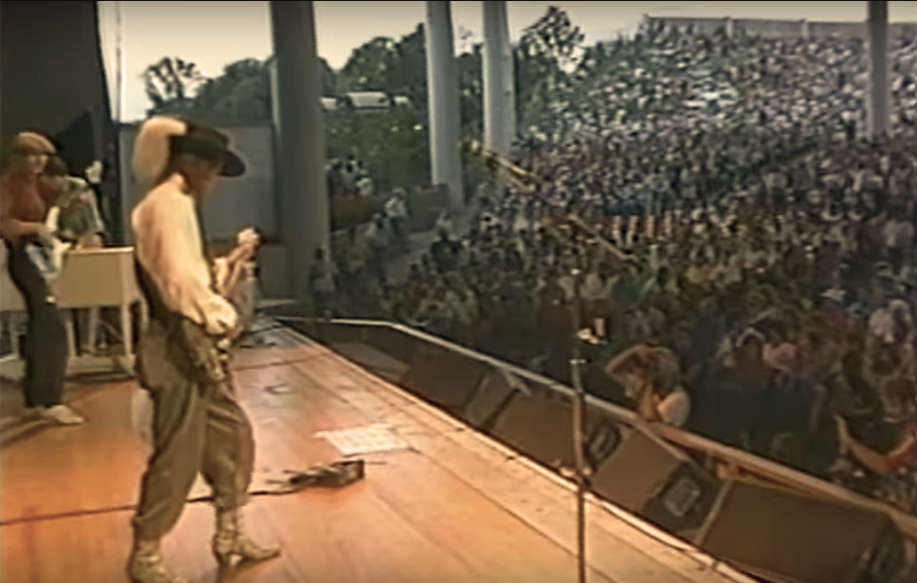
Whenever I see this shot of Stevie Ray Vaughan in Nashville, I imagine him twenty years younger, practicing in the basement by himself or with friends.
As his audition grew, so did his skills and his stage presence, until he could perform with supreme cocky-confidence before a crowd the size of a small metropolis. A phenomenal trajectory that didn't happen overnight. Each stride, from basement to nightclub to arena, was more than daunting than the last.
Now think of all the potentially swell guitarists who never left the "safety" of the basement.
Yes, putting yourself out there exposes you to both the actual and the wannabe critics of the globe. But it's a small price to pay for moving upwardly. And playing small usually feels safer in hindsight. Once you expand and grow into it, the side by side level up feels much like the previous one.
Y'all'll Never Be Ready
My offset web log posts reached between 20-v and fifty readers each. Absolutely, the posts were lame, but I was thrilled with any result.
Considering I didn't feel I had the ability, or fifty-fifty the right, to publish anything, and never dreamed in that location would exist a response. Which also meant in that location wasn't a affair to lose.
A few years afterwards, ane of the posts reached 28,000 readers and received 6,500 social media shares.
Pocket-sized, next to the millions of views that top bloggers are getting. But all the same a lot of eyeballs for a new-ish blogger. Today, getting two thousand readers for a post is a thwarting. And my mitt still trembles whenever it hovers over the publish button.
The indicate is that there's no right time to jump in. If you await until yous're comfortable, the energy has already left the situation and it's probably likewise late.
So the starting time thing to exercise is to enter some small shows. Don't expect much attention, skillful or bad, but do expect to make a boatload of mistakes. It'southward OK, you're learning at this stage, and setting yourself upward for success.
Juried Shows are Everywhere
and Available to Everyone
Let me continue record and say that about juried shows are uneventful.
Few people nourish them, few critics review them, and few collectors buy from them. And because of the sheer volume of entries, chances of getting in at all are slim. Once the work is hung, every inch of wall space is crammed with a hodgepodge of styles, and so it's hard to stand out.
But none of that matters.
The goal hither is to get some exhibitions, and ideally some awards, on your resume. Gallerists and collectors want proof that your work has been vetted, and the more you lot can requite them, the better.
Realize that after viewing hundreds of entries–most of them excruciatingly dull–jurors tire and they lose focus. So how practice you want them to react when your work pops upward on the screen?
That'south correct, y'all want them to rejoice over having something to await at.
Then go for force over subtlety when choosing your submissions. Make sure they have plenty of bang to them, so they leap off the projector screen and wake everybody upward.
Don't endeavor to cover all bases by submitting a little of this and a footling of that. Choose a suite of works with a common theme—three figures, three landscapes, etc. When viewed as a group, each slice will strengthen the others and brand a powerful impression.
And recollect, rejection is unavoidable. If yous're accepted to three shows out of ten, then you're doing very well.
Artists Who Don't Showroom Are More Vulnerable
This isn't meant to sound critical, simply I find that artists with exhibition records tend to accept a thicker skin and a sense of humour about their work. Artists who don't exhibit seem to have criticism, and rejection, more personally.
And I'll be direct with y'all…it's probable that your showtime rejections will be painful and y'all might go angry at the jurors. The next few volition be abrasive, and, with experience, you'll exist able to laugh the others off. Simply none of that volition happen if yous isolate yourself.
Funny, simply a great fashion to handle rejection is to embrace it completely. So when it happens, get all in and collapse on the couch with your favorite junk food. Let yourself experience all the pain for about v minutes. Punch a pillow if you have to—then become off the burrow and enter another bear witness.
Final Thought—
Aim, Burn down, Ready
Putting your artwork on the line is one of the most courageous things you tin can practise. It volition energize you. It will expand y'all. It will change your artistic self-image.
You'll feel more professional person, even if y'all're not selling yet. You lot'll get clear on how to improve. You'll meet other artists and brand friends.
Or peradventure y'all'd rather avoid all the hassle and just pigment. Guess what…we all want to just pigment.
Merely only painting isn't a long-term strategy for growth. Competition drives so much of human endeavor; without information technology, we'd all be living in mud huts and pumping h2o out of the footing.
And so isn't it fourth dimension to move out of the hut?
Fourth dimension to first actually learning?
Time to ignore that insufferable critic living inside your caput?
You have a unique vision. If you lot didn't, you wouldn't be an artist to begin with.
Be generous with your art. If sharing it inspires only one person, and so it's more than worth the trouble. Especially if that person is you.
Christopher Gallego (@cdgallego) is a painter and blogger who teaches at the Art Students League of New York.
Source: https://asllinea.org/why-you-should-exhibit-your-art-even-if-youre-not-ready-yet/

Post a Comment for "What to Do With Your Art if You Do Not Want to Exhibit"