The Rime of the Ancient Mariner After Reading Check Answers
The Rime of the Ancient Mariner (originally The Rime of the Ancyent Marinere ) is the longest major poem past the English language poet Samuel Taylor Coleridge, written in 1797–1798 and published in 1798 in the first edition of Lyrical Ballads. Some modern editions employ a revised version printed in 1817 that featured a gloss.[1] Forth with other poems in Lyrical Ballads, it is often considered a signal shift to modern poetry and the beginning of British Romantic literature.[2]
The Rime of the Ancient Mariner recounts the experiences of a crewman who has returned from a long sea voyage. The mariner stops a human who is on his way to a wedding ceremony and begins to characterize a story. The Wedding-Invitee's reaction turns from bemusement to impatience to fear to fascination as the mariner'south story progresses, every bit can be seen in the language fashion: Coleridge uses narrative techniques such as personification and repetition to create a sense of danger, the supernatural, or serenity, depending on the mood in different parts of the verse form.
Synopsis [edit]
The poem begins with an old grey-bearded sailor, the Mariner, stopping a guest at a wedding ceremony to tell him a story of a sailing voyage he took long ago. The Wedding-Invitee is at first reluctant to listen, as the ceremony is about to brainstorm, simply the mariner's glittering eye captivates him.
The mariner's tale begins with his transport parting on its journey. Despite initial practiced fortune, the send is driven south by a storm and somewhen reaches the icy waters of the Antarctic. An albatross appears and leads the ship out of the ice jam where it is stuck, but fifty-fifty every bit the boundness is fed and praised by the ship's coiffure, the mariner shoots the bird:
[...] With my cross-bow
I shot the Albatross.[3]—lines 81–82
The crew is angry with the mariner, believing the albatross brought the south wind that led them out of the Antarctic. All the same, the sailors change their minds when the weather becomes warmer and the mist disappears:
'Twas right, said they, such birds to slay,
That bring the fog and mist.[3]—lines 101–102
They soon find that they made a grave mistake in supporting this criminal offense, every bit information technology arouses the wrath of spirits who and then pursue the ship "from the land of mist and snow"; the south wind that had initially diddled them due north at present sends the transport into uncharted waters near the equator, where information technology is becalmed:
Solar day after day, day after day,
Nosotros stuck, nor jiff nor motion;
Equally idle as a painted ship
Upon a painted ocean.Water, water, every where,
And all the boards did compress;
Water, water, every where,
Nor any drop to drink.The very deep did rot: Oh Christ!
That ever this should be!
Yea, slimy things did crawl with legs
Upon the slimy ocean.[iii]—lines 115–126

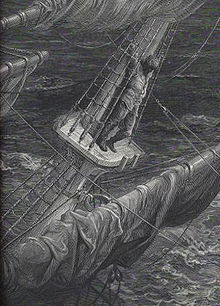
Engraving by Gustave Doré for an 1876 edition of the poem. The Boundness depicts 17 sailors on the deck of a wooden send facing an albatross. Icicles hang from the rigging.
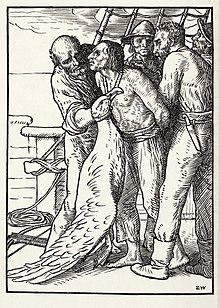
The sailors alter their minds again and blame the mariner for the torment of their thirst. In anger, the crew forces the mariner to wearable the dead albatross about his neck, perhaps to illustrate the burden he must suffer from killing it, or maybe equally a sign of regret:
Ah! well a-24-hour interval! what evil looks
Had I from old and young!
Instead of the cross, the Albatross
Almost my neck was hung.[3]—lines 139–142
After a "weary time", the send encounters a ghostly hulk. On board are Expiry (a skeleton) and the "Night-mare Life-in-Death", a deathly pale woman, who are playing dice for the souls of the coiffure. With a curl of the dice, Death wins the lives of the coiffure members and Life-in-Death the life of the mariner, a prize she considers more than valuable. Her name is a clue to the mariner'south fate: he will endure a fate worse than death as punishment for his killing of the albatross. 1 by i, all of the crew members die, simply the mariner lives on, seeing for seven days and nights the curse in the eyes of the coiffure's corpses, whose last expressions remain upon their faces:
Four times fifty living men,
(And I heard nor sigh nor groan)
With heavy thump, a lifeless lump,
They dropped down one by one.The souls did from their bodies fly,—
They fled to bliss or woe!
And every soul, information technology passed me by,
Like the whizz of my cross-bow![3]—lines 216–223
Eventually, this stage of the mariner'southward curse is lifted after he begins to appreciate the many ocean creatures swimming in the water. Despite his cursing them as "slimy things" before in the poem, he all of a sudden sees their true dazzler and blesses them ("A spring of love gush'd from my eye, And I bless'd them unaware"). As he manages to pray, the boundness falls from his neck and his guilt is partially expiated. It then starts to rain, and the bodies of the crew, possessed by skilful spirits, rising once again and help steer the send. In a trance, the mariner hears ii spirits discussing his voyage and penance, and learns that the ship is being powered supernaturally:
The air is cutting away earlier,
And closes from behind.[3]—lines 424–425
Finally the mariner wakes from his trance and comes in sight of his homeland, but is initially uncertain as to whether or non he is hallucinating:
Oh! dream of joy! is this indeed
The light-house pinnacle I meet?
Is this the hill? is this the kirk?
Is this mine own countree?Nosotros drifted o'er the harbour-bar,
And I with sobs did pray—
O permit me exist awake, my God!
Or let me sleep alway.[3]—lines 464–471
The rotten remains of the ship sink in a whirlpool, leaving only the mariner behind. A hermit on the mainland who has spotted the budgeted ship comes to meet information technology in a boat, rowed by a pilot and his boy. When they pull the mariner from the water, they think he is dead, but when he opens his mouth, the pilot shrieks with fearfulness. The hermit prays, and the mariner picks up the oars to row. The pilot's male child laughs, thinking the mariner is the devil, and cries, "The Devil knows how to row". Back on land, the mariner is compelled by "a woful agony" to tell the hermit his story.
As penance for shooting the albatross, the mariner, driven by the agony of his guilt, is now forced to wander the world, telling his story over and over, and teaching a lesson to those he meets:
He prayeth best, who loveth best
All things both great and small;
For the dear God who loveth the states,
He made and loveth all.[3]—lines 614–617
After finishing his story, the mariner leaves, and the hymeneals-guest returns home, waking the next morn "a sadder and a wiser man".
The poem received mixed reviews from critics, and Coleridge was once told by the publisher that most of the book'south sales were to sailors who thought it was a naval songbook. Coleridge made several modifications to the poem over the years. In the second edition of Lyrical Ballads, published in 1800, he replaced many of the archaic words.
Inspiration for the poem [edit]
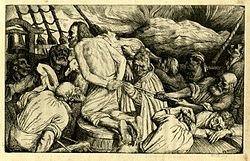
"The Albatross about my Neck was Hung," etching by William Strang. Poem illustration published 1896.
The poem may have been inspired past James Cook's second voyage of exploration (1772–1775) of the Southward Seas and the Pacific Ocean; Coleridge's tutor, William Wales, was the astronomer on Melt'south flagship and had a strong relationship with Melt. On this second voyage Melt crossed three times into the Antarctic Circle to decide whether the fabulous not bad southern continent Terra Australis existed.[a] Critics have too suggested that the poem may have been inspired by the voyage of Thomas James into the Arctic.[5]
Co-ordinate to Wordsworth, the poem was inspired while Coleridge, Wordsworth, and Wordsworth'southward sis Dorothy were on a walking tour through the Quantock Hills in Somerset.[6] The discussion had turned to a book that Wordsworth was reading,[7] that described a privateering voyage in 1719 during which a melancholy crewman, Simon Hatley, shot a black albatross.[b]
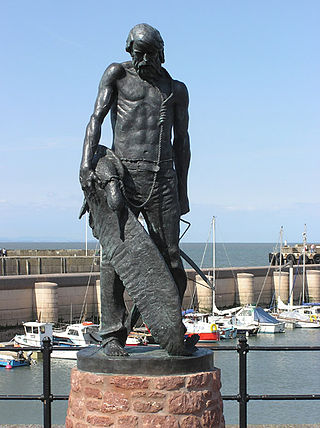
Commemorative statue at Watchet, Somerset: the albatross hangs on a rope looped around the ancient mariner's neck.
"Ah! well a-24-hour interval! what evil looks
Had I from old and young!
Instead of the cantankerous, the Albatross
About my neck was hung."[3] : lines 139–142
As they discussed Shelvocke's book, Wordsworth proffered the following developmental critique to Coleridge, which importantly contains a reference to tutelary spirits: "Suppose you represent him as having killed i of these birds on entering the south ocean, and the tutelary spirits of these regions take upon them to avenge the law-breaking."[6] By the time the trio finished their walk, the poem had taken shape.
Bernard Martin argues in The Ancient Mariner and the Accurate Narrative that Coleridge was as well influenced past the life of Anglican clergyman John Newton, who had a well-nigh-death experience aboard a slave send.[viii]
The verse form may also have been inspired by the legends of the Wandering Jew, who was forced to wander the earth until Sentence Day for a terrible crime, found in Charles Maturin'due south Melmoth the Wanderer, 1000. G. Lewis' The Monk (a 1796 novel Coleridge reviewed), and the fable of the Flying Dutchman.[nine] [10]
Information technology is argued that the harbour at Watchet in Somerset was the master inspiration for the poem, although some fourth dimension before, John Cruikshank, a local acquaintance of Coleridge's, had related a dream about a skeleton ship crewed by spectral sailors.[xi] In September 2003, a commemorative statue, by Alan B. Herriot of Penicuik, Scotland, was unveiled at Watchet harbour.[12]
[edit]
In Biographia Literaria, Coleridge wrote:
The thought suggested itself (to which of united states I do not retrieve) that a series of poems might be composed of ii sorts. In the one, incidents and agents were to exist, in part at least, supernatural, and the excellence aimed at was to consist in the interesting of the affections by the dramatic truth of such emotions, as would naturally back-trail such situations, supposing them existent. And real in this sense they have been to every homo existence who, from whatever source of delusion, has at whatsoever time believed himself under supernatural agency. For the second form, subjects were to be chosen from ordinary life ... In this idea originated the plan of the Lyrical Ballads; in which it was agreed, that my endeavours should be directed to persons and characters supernatural, or at least Romantic; all the same so as to transfer from our in nature a human being interest and a semblance of truth sufficient to procure for these shadows of imagination that willing pause of disbelief for the moment, which constitutes poetic faith. ... With this view I wrote the Ancient Mariner.[thirteen]
In Table Talk, Coleridge wrote:
Mrs. Barbauld one time told me that she admired The Ancient Mariner very much, but that there were ii faults in it – it was improbable, and had no moral. As for the probability, I endemic that that might admit some question; but as to the want of a moral, I told her that in my own judgement the verse form had besides much; and that the only, or principal error, if I might say and then, was the obtrusion of the moral sentiment and so openly on the reader as a principle or cause of activeness in a work of such pure imagination. It ought to have had no more moral than the Arabian Nights' tale of the merchant'due south sitting down to consume dates past the side of a well, and throwing the shells aside, and lo! a genie starts upward, and says he must impale the aforesaid merchant, considering one of the date shells had, it seems, put out the eye of the genie'southward son.[14]
[edit]
Wordsworth wrote to Joseph Cottle in 1799:
From what I can gather information technology seems that the Ancient Mariner has upon the whole been an injury to the volume, I mean that the old words and the strangeness of it take deterred readers from going on. If the volume should come up to a 2nd Edition I would put in its identify some fiddling things which would be more likely to suit the common taste.
However, when Lyrical Ballads was reprinted, Wordsworth included information technology despite Coleridge's objections, writing:
The Poem of my Friend has indeed great defects; outset, that the principal person has no distinct graphic symbol, either in his profession of Mariner, or every bit a homo existence who having been long under the control of supernatural impressions might be supposed himself to partake of something supernatural; secondly, that he does non act, but is continually acted upon; thirdly, that the events having no necessary connectedness practise not produce each other; and lastly, that the imagery is somewhat too laboriously accumulated. Withal the Verse form contains many delicate touches of passion, and indeed the passion is every where true to nature, a corking number of the stanzas present cute images, and are expressed with unusual felicity of linguistic communication; and the versification, though the metre is itself unfit for long poems, is harmonious and artfully varied, exhibiting the utmost powers of that metre, and every variety of which it is capable. It therefore appeared to me that these several claim (the offset of which, namely that of the passion, is of the highest kind) gave to the Poem a value which is not often possessed by better Poems.
Early on criticisms [edit]
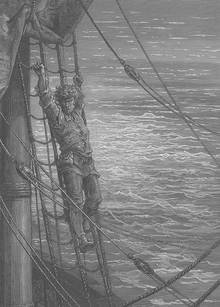
Upon its release, the verse form was criticized for existence obscure and difficult to read. The employ of archaic spelling of words was seen as non in keeping with Wordsworth's claims of using common linguistic communication. Criticism was renewed over again in 1815–1816, when Coleridge added marginal notes to the poem that were also written in an archaic way. These notes or glosses, placed next to the text of the poem, ostensibly interpret the verses much similar marginal notes found in the Bible. There were many opinions on why Coleridge inserted the gloss.[fifteen] Charles Lamb, who had deeply admired the original for its attention to "Human Feeling", claimed that the gloss distanced the audience from the narrative, weakening the poem's effects. The entire verse form was get-go published in the collection of Lyrical Ballads. Some other version of the poem was published in the 1817 collection entitled Sibylline Leaves (see 1817 in poesy).[sixteen]
Interpretations [edit]
On a surface level the verse form explores a violation of nature and the resulting psychological furnishings on the mariner and on all those who hear him. According to Jerome McGann the poem is like a salvation story. The verse form's structure is multi-layered text based on Coleridge's interest in higher criticism. "Like the Iliad or Paradise Lost or any neat historical product, the Rime is a work of trans-historical rather than and so-called universal significance. This exact distinction is of import considering it calls attending to a existent ane. Like The Divine Comedy or any other poem, the Rime is non valued or used ever or everywhere or by everyone in the same way or for the aforementioned reasons."[17]
Whalley (1947)[18] suggests that the Ancient Mariner is an autobiographical portrait of Coleridge himself, comparing the mariner's loneliness with Coleridge'southward ain feelings of loneliness expressed in his letters and journals.[eighteen]
Versions of the poem [edit]
Coleridge ofttimes made changes to his poems and The Rime of the Ancient Mariner was no exception – he produced at least eighteen different versions over the years.[nineteen] (pp 128–130) He regarded revision as an essential part of creating poesy.[xix] (p 138) The first published version of the poem was in Lyrical Ballads in 1798. The second edition of this anthology in 1800 included a revised text, requested by Coleridge, in which some of the language and many of the archaic spellings were modernised. He also reduced the championship to The Ancient Mariner only for later versions the longer title was restored. The 1802 and 1805 editions of Lyrical Ballads had minor textual changes. In 1817 Coleridge's Sibylline Leaves anthology included a new version with an extensive marginal gloss, written by the poet. The concluding version he produced was in 1834.[twenty] [nineteen] (pp 127, 130, 134)
Traditionally literary critics regarded each revision of a text by an author equally producing a more authoritative version and Coleridge published somewhat revised versions of the poem in his Poetical Works album editions of 1828, 1829, and lastly in 1834 – the year of his decease. More recently scholars wait to the earliest version, even in manuscript, as the nigh authoritative but for this verse form no manuscript is extant. Hence the editors of the edition of Collected Poems published in 1972 used the 1798 version but made their ain modernisation of the spelling and they added some passages taken from subsequently editions.[xix] (pp 128–129, 134)
The 1817 edition, the one most used today and the first to be published under Coleridge's own name rather than anonymously, added a new Latin epigraph but the major change was the add-on of the gloss that has a considerable outcome on the fashion the verse form reads.[21] (p 186) [22] [23] [19] (pp 130, 134) Coleridge'due south grandson E.H. Coleridge produced a detailed written report of the published versions of the poem.[21] Over all, Coleridge'southward revisions resulted in the verse form losing thirty-nine lines and an introductory prose "Argument", and gaining fifty-eight glosses and a Latin epigraph.[nineteen] (p 134)
In general the anthologies included printed lists of errata and, in the case of the especially lengthy listing in Sibylline Leaves, the list was included at the get-go of the volume. Such changes were frequently editorial rather than merely correcting errors.[nineteen] (pp 131, 139) Coleridge also fabricated handwritten changes in printed volumes of his work, particularly when he presented them as gifts to friends.[19] (pp 134, 139)
In popular culture [edit]
In improver to being referred to in several other notable works, due to the popularity of the poem the phrase "boundness effectually one'south neck" has become an English-linguistic communication idiom referring to "a heavy burden of guilt that becomes an obstacle to success".[24]
The phrase "Water, water, every where, / Nor any drop to drink" has appeared widely in popular culture, only usually given in a more natural modern phrasing as "Water, h2o, everywhere / But not a driblet to drink"; some such appearances accept, in plow, played on the frequency with which these lines are misquoted.[25]
See likewise [edit]
- Albatross (metaphor)
Notes [edit]
- ^ "On 26 Jan 1774 he crossed into the Antarctic Circle for the third time (having done so a second fourth dimension the previous month) and 4 days after, at 71°x' S, 106°54' W, accomplished his uttermost south."[4]
- ^ "We all observed, that we had not the sight of one fish of whatsoever kind, since nosotros were come up to the Due south of the straits of le Mair, nor one sea-bird, except a disconsolate black Albatross, who accompanied us for several days ... till Hattley, (my second Helm) observing, in one of his melancholy fits, that this bird was always hovering most us, imagin'd, from his colour, that it might be some ill omen ... He, after some fruitless attempts, at length, shot the Albatross, not doubting we should have a fair wind later on it."[7] [ page needed ]
References [edit]
- ^ "Revised version of the Rime of the Aboriginal Mariner, published in Sibylline Leaves". The British Library . Retrieved 1 October 2019.
- ^ "The characteristics of romanticism found in The Rime of the Ancient Mariner". education.seattlepi.com . Retrieved 1 October 2019.
- ^ a b c d e f g h i Coleridge, Samuel Taylor (1921). Coleridge, Due east.H. (ed.). The Poems of Samuel Taylor Coleridge. Oxford University Press. pp. 186–209.
- ^ David, Andrew C.F. (January 2008) [2004]. "Cook, James (1728–1779)". Oxford Lexicon of National Biography (online ed.). Oxford University Press.
- ^ Cooke, Alan (2000). "Thomas James". Dictionary of Canadian Biography (Online ed.). Retrieved 5 March 2007.
- ^ a b Coleridge, Southward.T. (1997). Keach, William (ed.). The Complete Poems / Samuel Taylor Coleridge. Penguin Books. pp. 498–499.
- ^ a b Shelvocke, George, Captain (1726). A Voyage Round The World by Way of the Great Due south Body of water.
- ^ Martin, Bernard (1949). The Ancient Mariner and the Authentic Narrative. William Heinemann.
- ^ Fulmer, O. Bryan (Oct 1969). "The aboriginal mariner and the wandering jew". Studies in Philology. 66 (5): 797–815. JSTOR 4173656.
- ^ Clute, John; Grant, John, eds. (1999). The encyclopedia of fantasy. Macmillan. p. 210. ISBN978-0-312-19869-v.
- ^ "Samuel Taylor Coleridge". poetryfoundation.org. xi Dec 2016. Retrieved 12 December 2016.
- ^ "Coleridge and Watchet". watchetmuseum.co.uk. Watchet Museum. Retrieved 12 December 2016.
- ^ Coleridge, Samuel Taylor. "Chapter XIV". Biographia Literaria . Retrieved 12 May 2013.
- ^ "TableTalks, p. 106". Archived from the original on 15 Apr 2014. Retrieved 1 March 2014.
- ^ Wu, Duncan (1998). A Companion to Romanticism. Blackwell Publishing. p. 137. ISBN0-631-21877-7.
- ^ "About The Rime of the Aboriginal Mariner". GradeSaver. Study Guide for The Rime of the Ancient Mariner.
- ^ McGann, Jerome J. (1985). The Beauty of Inflections. Clarendon Printing.
- ^ a b Whalley, George (July 1947). "The mariner and the boundness". University of Toronto Quarterly. xvi (4): 381–398. doi:x.3138/utq.sixteen.4.381.
Reprinted in
Coburn, Kathleen, ed. (1967). Coleridge: A collection of critical essays . Prentice-Hall. - ^ a b c d east f m h Stillinger, Jack (1992). "The multiple versions of Coleridge's poems: How many Mariners did Coleridge write?". Studies in Romanticism. 31 (two): 127–146. doi:10.2307/25600948. JSTOR 25600948.
- ^ Coleridge, S.T. (1836). The poetical works of S.T. Coleridge. Vol. 2. London, UK: William Pickering. pp. 1–27.
- ^ a b Coleridge, S.T. (1912). Coleridge, E.H. (ed.). The Complete Poetical Works of Samuel Taylor Coleridge. Vol. I. Oxford: The Clarendon Press.
Coleridge, S.T. (1912). Coleridge, East.H. (ed.). The Complete Poetical Works of Samuel Taylor Coleridge. Vol. II. Oxford: The Clarendon Press. - ^ Perry, Seamus (15 May 2014). "An introduction to The Rime of the Ancient Mariner". Discovering Literature: Romantics & Victorians. The British Library.
- ^ Jack, Belinda (21 February 2017). "Samuel Taylor Coleridge's The Rime of the Ancient Mariner and poetic technique". Gresham College. pp. 4, 5, 10.
- ^ "albatross around one's neck". Houghton Mifflin. 1997.
- ^ Merz, Theo (21 January 2014). "X literary quotes we all get wrong". The Telegraph. Archived from the original on 12 January 2022. Retrieved 26 July 2016.
Sources [edit]
- Gardner, M. The Annotated Ancient Mariner. New York, NY: Clarkson Potter, reprinted by Prometheus Books. ISBN1-59102-125-one.
- Lowes, J.L. (1927). The Road to Xanadu – a report in the ways of the imagination. Houghton Mifflin.
- Scott, Grant F. (2010). ""The many men so cute": Gustave Doré'south illustrations to The Rime of the Ancient Mariner". Romanticism. 16 (i): 1–24.
External links [edit]
- Illustrations from The Rime of the Ancient Mariner, Gustave Doré illustrations from the University at Buffalo Libraries' Rare & Special Books collection
- The Rime of the Ancient Mariner, text from Project Gutenberg
- The Rime of the Ancient Mariner, audiobook (Jane Aker) from Project Gutenberg
- The Rime of the Aboriginal Mariner : Disquisitional Analysis and Summary
-
 The Rime of the Ancient Mariner public domain audiobook at LibriVox
 - Abstracts of literary criticism of The Rime of the Ancient Mariner
Source: https://en.wikipedia.org/wiki/The_Rime_of_the_Ancient_Mariner

Post a Comment for "The Rime of the Ancient Mariner After Reading Check Answers"