What About the Structure of the Eiffel Tower Became a Hallmark of 20th Century Art and Architecture?
Nosotros can admire the French for many things - their cuisine, their fashion, their vino, their art, their artists and a vast number of major art movements - but let us not forget their flamboyant architecture. Throughout history, French architecture played a few seminal roles, giving birth to some of the most famous architectural styles and presenting itself as a role model for the balance of the world. Equally for the most recent menses, a few starchitects are immediately associated with France, such as the world-famous Jean Nouvel and Dominique Perrault. Even the father of Modernism, Le Corbusier, is a bit of a Frenchman himself, although he was built-in in due north-western Switzerland (but still simply 5 km away from the French border). Let's explore how the French architecture changed throughout history.
Early Beginnings - The Romans in Gaul
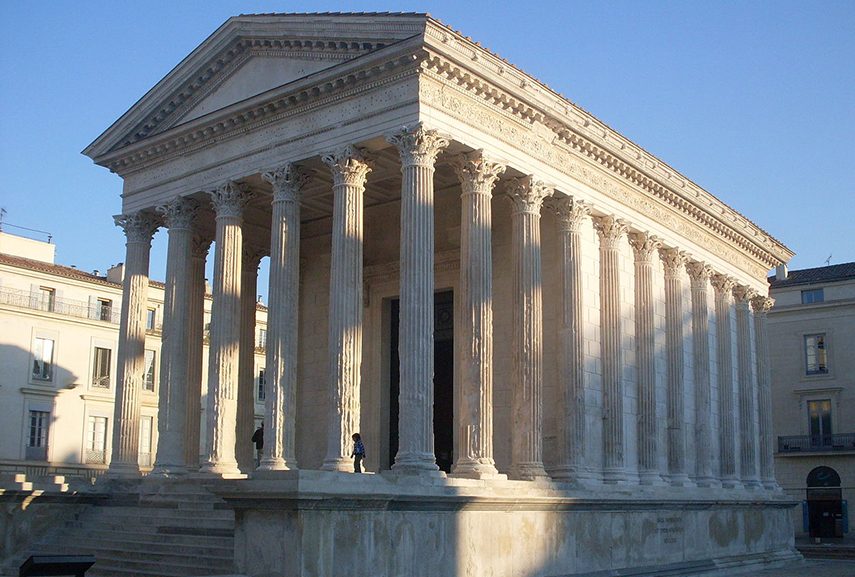
The story of French compages begins in the Roman menstruation, when the region of Gaul was under the rule of the Roman Empire. The remnants of some notable Galo-Roman designs in France have fortunately been preserved, such as Maison Carree and Amphiteatre in Nimes, The Gallo-Roman Museum of Lyon-Fourvière in Lyon, or Alyscamps in Arles, one of the about famous necropolises from the ancient period. Furthermore, one tin can find the remains of some interesting pieces of ancient infrastructure across France, such equally the channel Pont du Gard in Nimes and Barbegal mill near Arles. All of the typical characteristics of Roman compages were made manifest here likewise - the emergence and deployment of concrete, and the utilization of arches and vaults. [1]
Religious Buildings from Pre-Romanesque Period
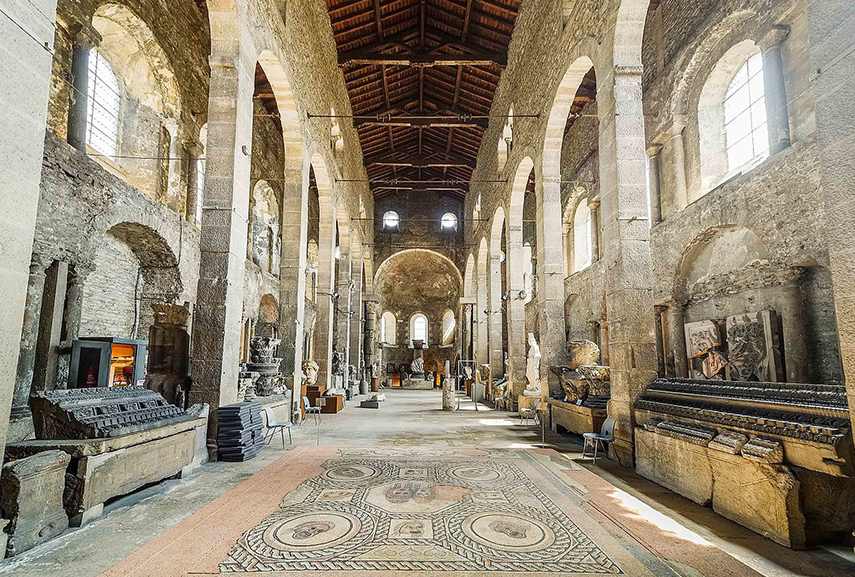
Afterwards all the Frankish tribes were unified under the reign of a single ruler, Clovis I in the 5th century, a greater emphasis was placed on the edifice of churches and monasteries. Naturally, architecture responded to these needs and served the purpose of the mediator and translator between the secular and the sacred, by the principles of the Merovingian church. In this period, the church edifice plans were extending upon the Roman basilica tradition, but they were also influenced past other types of architectural innovations, some of them originating in the East (Syria and Armenia). Besides the apparent cultural legacy of the Romans and other sources of affect, information technology is believed that the French had a few seminal inventions in this pre-Romanesque period that were not seen before. Such is the contradistinct position of the sarcophagus, raised to be visible.[2] Unfortunately, since most of the major churches were re-built in one case they became stylistically outdated, nosotros are merely able to learn near the French architecture of this period from archaeological reconstructions and writings. A rare surviving church building from this era is Saint Peter's church (Saint-Pierre-le-Bas) in Vienne, Lyon.
Romanesque Compages - French Either Way
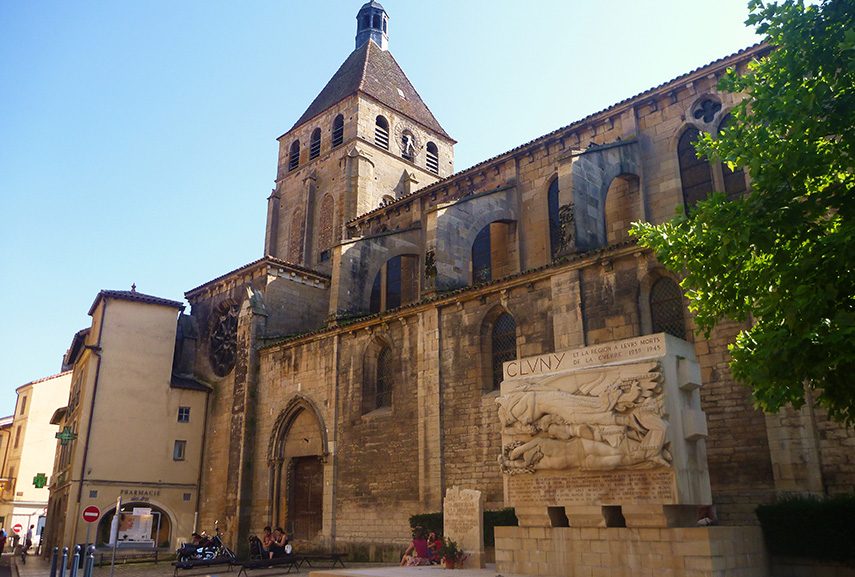
The first unified manner to arise in Europe in the Middle Ages was Romanesque style. Incidentally, the name literally means "descended from Roman", which comes as a paradox since it is the start large affair to emerge after the fall of the Romans. Even though nosotros take the context of the tenth century as the forerunner of Romanesque architecture, it is hard to discern the verbal date and place of its origin. There are many examples of buildings in northern Italy and France dating from the menstruation betwixt the eighth and the tenth century that have some Romanesque features and this is called First Romanesque or Lombard Romanesque. [3] They were still designed before the manner was more than widely recognized and established, when near of the Romanesque compages was influenced by the Abbey of Cluny. Do notice that French republic is associated with this style either way, which makes it inseparable from the story. Both the early and the late Romanesque style is characterized by thick walls and piers from which the domes arose, reductive approach to ornamentation and sculpture and a rhythmic repetition, both on the facade (through identical windows and arches on the facade) and in terms of structure (arches that establish the nave). A typical characteristic is the use of three portals that lead into the nave. In the after flow, from the early 13th century onward, the constructions were increasingly busy by pinnacles and long spires. These features gave impetus to the recognizable Gothic style later.
Gothic Compages, Previously Known as French Work
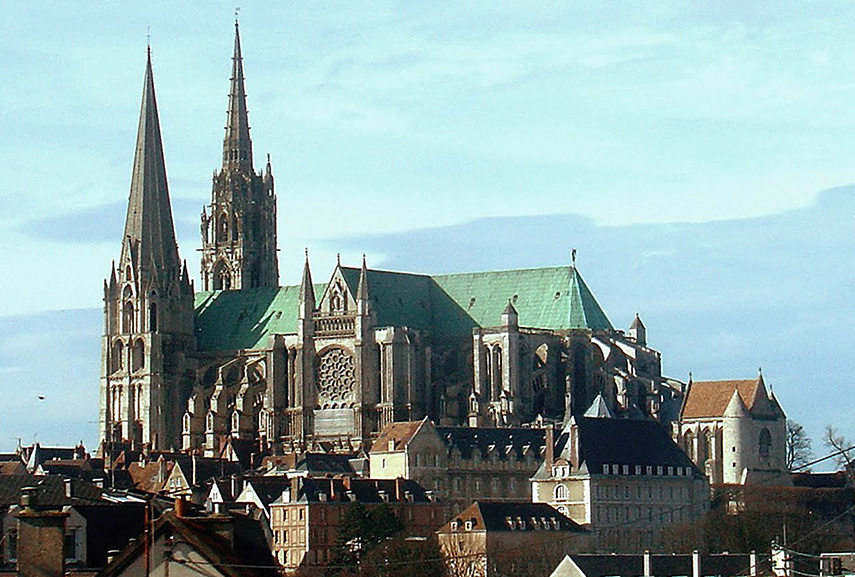
From the mid-12th century until 1500, French Gothic compages was a predominant 1 in Europe. Fifty-fifty to this solar day, it stays ane of the most typical French architectural styles with a unique, distinct character. Interestingly, the term was first used in the Renaissance, and was before known equally Opus Francigenum which means french work. Gothic architecture is historically divided into separate styles, including Early Gothic, High Gothic, Rayonnant and Late or Flamboyant style. Just like it happens with its predecessor, at that place are still debates over this strict segregation. The Early on one was a direct successor of Romanesque architecture, with an adoption of the pointed arch as an element and an accent on the top of the walls and ceiling. In order to achieve this, architects combined arcades with a gallery, a triforium (a shallow gallery located in the inner wall of a church) and a clerestory, another line of arches placed above the original arcade, usually with windows providing low-cal and/or fresh air. To make the construction stable, the builders invented flight buttresses, besides called counterforts, that were used to support the high walls. Every bit information technology turned out, this structural chemical element became one of the most feature emblems of Gothic architecture, often even seen as an object of beauty or decoration. Some other significant invention was a half-dozen-ribbed, sexpartite vault, which was afterward replaced by the four-ribbed vault. Loftier Gothic style followed the initial canons, aspiring to reach greater edifice heights, but with a tendency to make the structure lighter. This is i of the reasons why the four parts of a wall were reduced to iii, and gallery was eventually dropped out. Equally a result, clerestory progressed from having a single window in each segment to a pair of windows, conjoined past a rose window in the middle.
The two other styles of French Architecture of the flow, Rayonnant and Flamboyant, are both derived from High Gothic architecture, only its builders were more concerned with the two-dimensional, decorative aspects than the structural aspects and the actual employ of infinite. The latter is supposed to be the stylistic "child" of the old, although the actual point of transition was never made entirely clear. The desire to display a calorie-free, nonetheless circuitous and tall structure and to play with illumination was further explored during this catamenia. The Rayonnant period coincided with several innovations related to glass and window glazing, which afflicted the subsequent change in window design. They used larger windows and introduced a glazed triforia, as well as a significant modify in the window tracery design - the windows were no longer framed by plates only appeared as if they were gently touched by sparse confined.[iv]
Renaissance in French Architecture
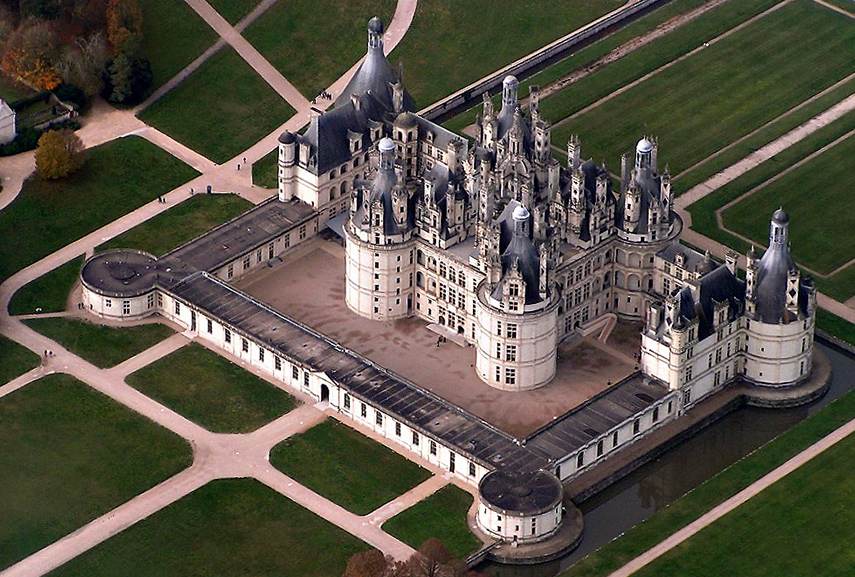
After it started spreading from Italy, the Renaissance left a mark on almost every corner of Europe, or at to the lowest degree the Western part for sure. In France, it became the prevalent type of compages used mostly for designing chateaux and typically affiliated with the royals. Quite soon subsequently its initiation in the late 15th century, it transformed into French Mannerism. This manner of French compages was better known under the name of Henry II, who worked with Italian architects and artists to help him pattern the Palace of Fontainebleau. They also founded the Outset School of Fontainebleau, which is ane of the two schools that marked the era of taught artistic production in France during the 16th and early 17th century.

The French Baroque
During the reigns of 3 famous similarly named French kings, Louis XIII, 14 and Fifteen, an era of French Baroque blossomed. Ane single building, the Luxembourg Palace in Paris, was proclaimed the "role-model" for all other baroque structures in France, as it became the embodiment of the open iii-wing layout, with a revolutionary twist. The building designed by Salomon de Brosse was the first one to explicitly emphasize the entry, east.g. the centre wing, and to make the ii side wings seem junior to the cardinal one. This later on became a recognizable feature of Louis XIII style.[5] The same mode was successively deployed by other architects in constructions of similar kind, such as Château de Maisons designed past Francois Mansart or the Palace of Versailles, designed past 3 masters who joined forces to create a hallmark of French architecture, the architect Louis Le Vau, designer Charles Le Brun and gardener André Le Nôtre. For this occasion, the concept of the French formal garden, in which symmetry and club take over nature, was introduced. It complimented the building that was inspired by the Bizarre villas, but washed in a more classical French manner.
Rococo - Golden Stones and Shells
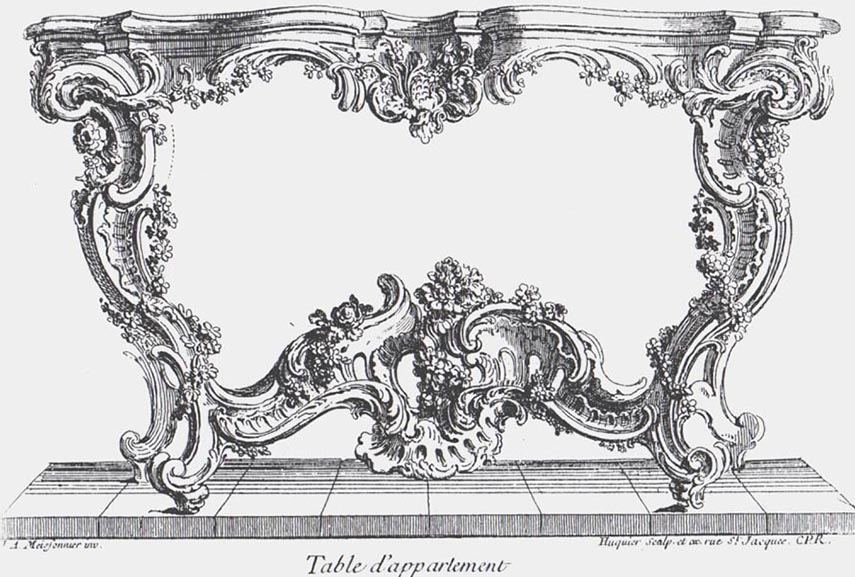
Whereas the Renaissance and Bizarre were both originally associated with Italian republic, Rococo (sometimes spelled Roccoco) was more of a French affair from the commencement. The proper noun is probably a coinage made out from the words rocaille (stone) and coquilles (shell), both of which are its recurring motives. It has groovy similarities with Belatedly Baroque, with which information technology is sometimes interchangeable, in terms of a more than humorous and open arroyo to composition and architectural design. While the Bizarre was generally more playful than the rigorous Renaissance, Rococo has taken this to the extreme, offering an explicitly non-symmetrical, colorful, curvilinear and excessively ornamental arroyo. This overabundance of ornament typical for Rococo is the one nosotros would usually attribute to the thriftless reigns of Louis Xv and Louis 16, and this is not an accident, as they are both connected to it. However, Rococo presently became an international style, as it spread out to other parts of Europe, Vienna, Prague, Lisbon, etc.
Neoclassical Movements in French Architecture
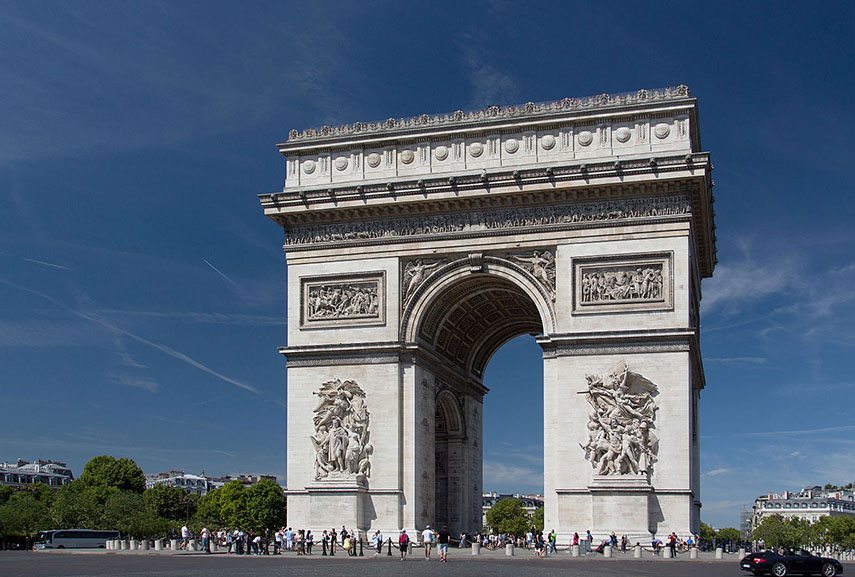
Rococo was before long replaced by Neoclassicism, and although this happened during Louis Xvi'due south reign, it could be associated with the significant changes that happened in France at the end of the 18th century. Rococo was condemned both by the people who linked it to the monarchy and the historians who had no understanding of the "playful" graphic symbol, describing it simply as bad gustation (which is not to say that this matter shouldn't exist revisited today). Neoclassicism, then, came every bit a render to social club. Several streams were notable in this period, one of them being the Greek Revival that lasted until the end of the 19th century, when it was finally seen as counter-modern and counter-progressive. Information technology coincided with Romanticism and Gothic Revival. Interestingly, Greek Revival was never a pop way, neither among the ordinary people nor the country - as if the orderly, rigorous compages simply does not stand for with the French gustatory modality.
Paris and France in the 19th Century
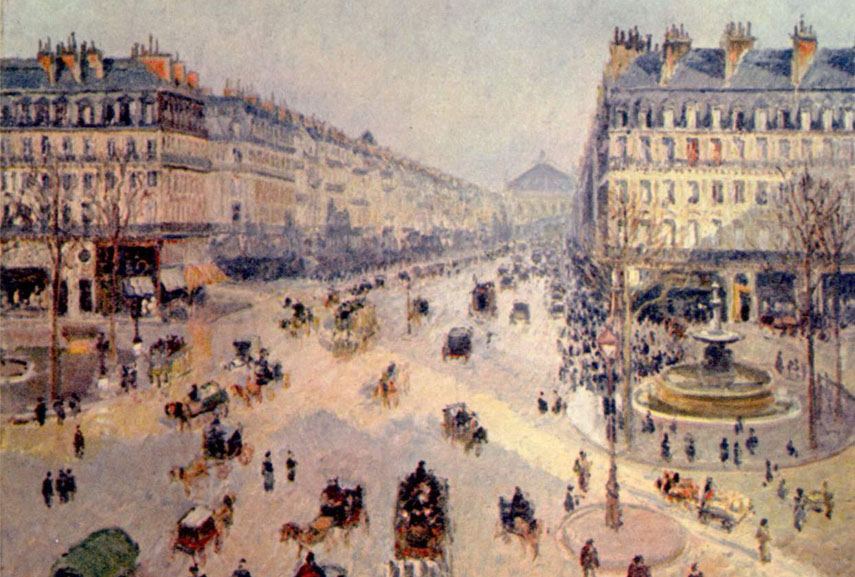
In the second half of the 19th century, France was under the regime of Napoleon III, which is when Paris was practically refurbished by Baron Haussmann. Proclaimed the about beautiful city in the world by many, Paris owes most of it to this period, during the Second Empire. New monumental constructions were made in an impressive, tall manner, many of the old ones were embellished, the streets were accompanied by lines of trees and street fronts became unified by cream-colored stone tiles. In this menstruation, a trapezoid-shaped rooftop was popularized, called a mansard. This boxy roof has become a symbol of French compages.[6]
On the other manus, the 19th century saw the beginning of a new era in architecture everywhere. In 1889, Paris was the host of an important international exposition, the Universal Exposition, during which the French unveiled their latest engineering achievement - the Eiffel Tower. This was a symbol of the Belle Epoque but also a mode of showing that the Parisians are stepping up with the modern world, aslope the British and their Crystal Palace. The 1889 Expo was followed by the emergence of Art Nouveau, which was embraced for a brusk period by the French, and was soon replaced by Art Deco, right earlier the burst of World State of war I.
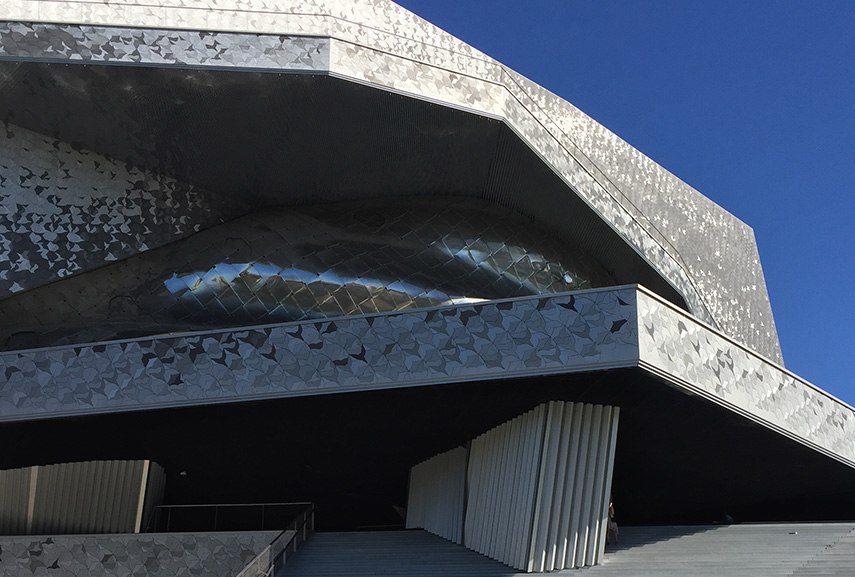
Modernism and Contemporary French Compages
The 20th century was the era of major changes, and so it happened in France and their architecture equally well. After the First World War, in that location were two opposing streams - the tradition-based Beaux-Arts and the Modernists, centered effectually Le Corbusier and Robert Mallet-Stevens. As we all know today, both streams establish a way to coexist, even with Le Corbusier's radical urban plans that scared the Parisians. For better or for worse, he never got a adventure to really erase one-half of Paris's historical core, just his architectural designs marked the rest of France - 1 of the most famous beingness the iconic Villa Savoye in Poissy, the suburbs of the French capital letter. The influence of Le Corbusier and his contemporaries is quite axiomatic today, even when seen with a harsh critical eye. In today'southward era of post-postmodernism, nosotros take the privilege to enjoy the glamorous compages of Jean Nouvel, built all over the world, and also to re-interpret the pregnant of glamour through all of his peculiar designs. Moreover, the French have given us a few post-structuralists, namely Derrida and Deleuze, who have inspired world's most famous architects, such equally Peter Eisenmann. That is to say that the French still play a cardinal role in the history of architecture, even in the most unexpected ways.
References:
Featured images: Eiffel Tower in Paris; Notre-Matriarch Cathedral in Paris; Le Corbusier's Notre Dame du Haut, Ronchamp. All images used for illustrative purposes only.
Source: https://www.widewalls.ch/magazine/french-architecture

Post a Comment for "What About the Structure of the Eiffel Tower Became a Hallmark of 20th Century Art and Architecture?"